Holy Week 2026: Palm/Passion Sunday
Gospel Reading: Matthew 21:1–11
1When they had come near Jerusalem and had reached Bethphage, at the Mount of Olives, Jesus sent two disciples, 2saying to them, “Go into the village ahead of you, and immediately you will find a donkey tied, and a colt with her; untie them and bring them to me. 3If anyone says anything to you, just say this, ‘The Lord needs them. ‘And he will send them immediately.” 4This took place to fulfill what had been spoken through the prophet, saying, donkey, and on a colt, the foal of a donkey.” 5“Tell the daughter of Zion, Look, your king is coming to you, humble, and mounted on a donkey, 6The disciples went and did as Jesus had directed them; 7they brought the donkey and the colt, and put their cloaks on them, and he sat on them. 8A very large crowd spread their cloaks on the road, and others cut branches from the trees and spread them on the road. 9The crowds that went ahead of him and that followed were shouting, “Hosanna to the Son of David! Blessed is the one who comes in the name of the Lord! Hosanna in the highest heaven!” 10When he entered Jerusalem, the whole city was in turmoil, asking, “Who is this?” 11The crowds were saying, “This is the prophet Jesus from Nazareth in Galilee.”
Reflection: Rejecting Triumphalism by David Morrison
It’s interesting that this event–of Jesus riding on a pony (or donkey) into the great feast in Jerusalem with the messianic cries of the crowd is traditionally called the “triumphal entry.” I’m not aware of the history of how this event has come to be titled: maybe it’s meant to be ironic? Maybe people so ensconced in Christian triumphalism meant it literally? Regardless, when read in the context in the whole of Mark’s gospel, Jesus is engaging in prophetic parody—mocking the great leaders of the dominant empires of history. Earlier that day, it’s very likely that Pontius Pilot would have arrived from his villa for the feast and entered the city on a war horse with a color guard and with great pomp. Jesus arrives in the city on a small draft animal, probably dragging his feet on the ground instead of a white stead. Instead of a great army, the peasants shout cryptic messianic expectations. When it’s over, he doesn’t ascend David’s throne. He doesn’t confront the Romans or the Temple authorities. He sends the pony home, and walks to Mary and Martha’s house. The whole action is intentional as if he knew it was time to provoke the powers and see what they would do with him. He resolutely entered into the ultimate of love–not a superficial love, but a love that can transform crucifixion into resurrection. Christian spirituality is the practice of living and moving through the illusion and projection of love and into its essence and reality. “With Jesus there is no superficial love; instead, we are given a love that withstands the horror of crucifixion. It is the kind of love that displays how illusive our sense of reality often is” (Michael Battle).
If you’ve grown up in North American culture, you have been trained all your life to expect Jesus to make your life a “triumphal entry” into the “winner’s circle.” The reality of love calls us to follow Jesus into the same great humility. We can NEVER experience the resurrection unless we’ve died. We can’t receive grace and healing unless we’ve failed and we’re sick. Only sinners get saved—not the winners of religious purity contests. But what seems to happen after someone experiences grace? For a time, they seem to follow Jesus in the way of humility, but very often turn around and become religious oppressors. The work of humility must continue as we realize God is not really interested or impressed by our “triumphs” in life, but the Spirit is always hovering over the depths of our vulnerabilities and fragility which are the materials for a new creation to occur.
Prayer:
“Rise now, my soul, handmaid of the Savior, join the procession of the daughters of Zion and go out to meet your King. Accompany the Lord of heaven and earth, seated on a donkey; follow him with olive and palm branches, with works of piety and with victorious virtues” (St. Bonaventure). Divine Spirit, take me into yourself in order to accompany Jesus further from the adoring crowd to the path of His passion, suffering, and death. Grant me joint intimacy with the Son’s wounds so that I may drink fully the joy of His resurrection. Amen (DM).
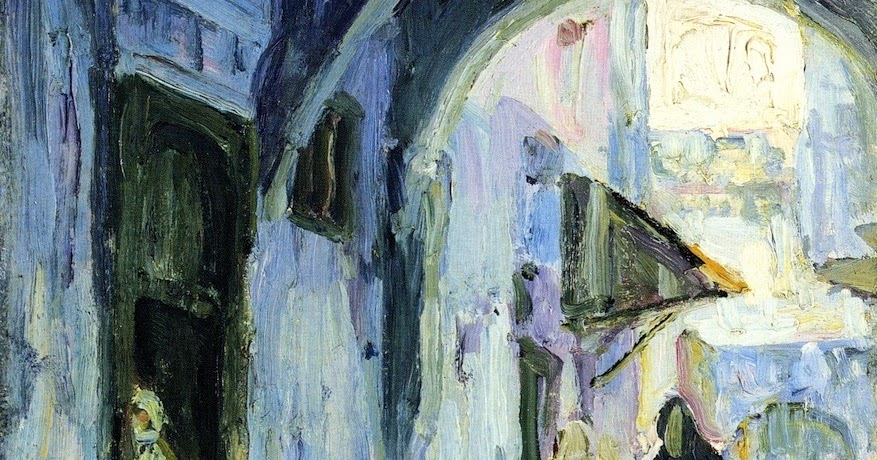
Street in Tangiers, 1912 (Henry Ossawa Tanner)