Gospel Reading:
Matthew 11:2–11
2When John heard in prison what the Messiah was doing, he sent word by his disciples 3and said to him, “Are you the one who is to come, or are we to wait for another?” 4Jesus answered them,”Go and tell John what you hear and see: 5the blind receive their sight, the lame walk, the lepers are cleansed, the deaf hear, the dead are raised, and the poor have good news brought to them. 6And blessed is anyone who takes no offense at me.” 7As they went away, Jesus began to speak to the crowds about John: “What did you go out into the wilderness to look at? A reed shaken by the wind? 8What then did you go out to see? Someone dressed in soft robes? Look, those who wear soft robes are in royal palaces. 9What then did you go out to see? A prophet? Yes, I tell you, and more than a prophet. 10This is the one about whom it is written, ‘See, I am sending my messenger ahead of you, who will prepare your way before you.’ 11Truly I tell you, among those born of women no one has arisen greater than John the Baptist; yet the least in the kingdom of heaven is greater than he.”
Reflection by David Morrison
The gospel of John, after opening with the hymn of the cosmic Christ, introduces a figure who appears in the context of the political powers of oppression over the Jewish people. It’s in this very real, and vulnerable time in which John “the voice” appears in the middle of nowhere-the Judean desert. He puts off all queries as to who he is, and only settles on “a voice in the wilderness.” He was a strange figure in his original context and he’s even stranger now in our American consumer Christmas landscape. Do we dare let a wild animal in our homes? Do we dare listen to a wild voice crying out in the desert of our souls? He’s out of place in the popular conception of Christmas, much like the children martyrs that Herod murdered. These unpleasant realities don’t mix well with happy jingles and shiny tinsel. David Bartlett writes: “Maybe John becomes a symbol of those of us who stand slightly at the margins every Advent and Christmastide, knowing that something big is about to happen but not quite knowing how to be part of the party.¹
The “voice in the wilderness,” in the interior sense, is that voice of our own soul or perhaps the Holy Spirit (probably in tandem or unison), that sings us toward healing and wholeness (salvation). It’s the last voice we listen to and sometimes we actively avoid it because we are avoiding ourselves in our pain, shame, and traumas. We need the grace of courage to listen to it and begin to follow it—though it’s a wild song. The religious leaders wanted an identity or category to which to fix John. I’m no different. I sometimes think of John as the archetype of “hermit,” and other times, as the “holy fool.” He was born in the royalty of the temple industrial complex with all its social, religious, and consumer advantages, yet at some point, he rejected it all and went for the desert. And so there’s a foolishness or a comedic element in following the vision of the gospel. So in that spirit, it reminds me of the famous song, “Rainbow Connection.” Paul Williams wrote it specifically for Kermit the Frog. One verse speaks to me of the “voice in the desert”: “Have you been half-asleep? / And have you heard voices? / I’ve heard them calling my name / Is this the sweet song that calls the young sailors? / The voice might be one and the same. / I’ve heard it too many times to ignore it / It’s something I’m supposed to be…”² Sometimes the words of the prophets are sung in mouths of Muppets. It truly is a voice that’s heard from the margins and thin places within the heart.
John was sent as a “witness to the light.” This has a specific implication for John’s life and ministry, but what does it mean for us today? What are we to witness and give testimony? John’s gospel opens with a Greek reference to the “Logos” (In the beginning was the Word”) and the gnostic dualistic philosophy of “light vs. darkness” in order to present a Christ that transcends this by demonstrating the divine completely and authentically embodying humanity (incarnation). The Christ presented in John also transcends the first century, Jewish messianic expectation as well by demonstrating the path of surrender, healing, and emptying (kenosis) that Christ takes instead of militarism, nationalism, and political and social dominance. How do we engage this process of giving “witness” to the light? I would speculate we begin from within and “bear witness” to the indwelling Christ. Most of the time, it would seem that spiritual/religious and even therapeutic/self-care paths really only offer techniques and self-delusions to avoid ourselves. These may be helpful for a temporary time in offering distraction and brief emotional pain relief, but they do not lead us to become, like John, “witnesses of the light.” The gospel invites us to sit in the depths and dark of our traumas and vulnerability. In this process (incarnation), we encounter the light of our belovedness which is untouched and untouchable. It is absolute gift and not earned. It is eternal, and not attached at all to any of our life’s achievements or failures. It has nothing to do with our own moral excellence or defeat. When we encounter this inner life of love, we begin to witness it everywhere around us.
Prayer:
Prayer while lighting the third candle each evening:
Speak the Eternal Word into our souls:
Let it sound as the voice in the wilderness of the world.
Let us be witness to the Light of Love.

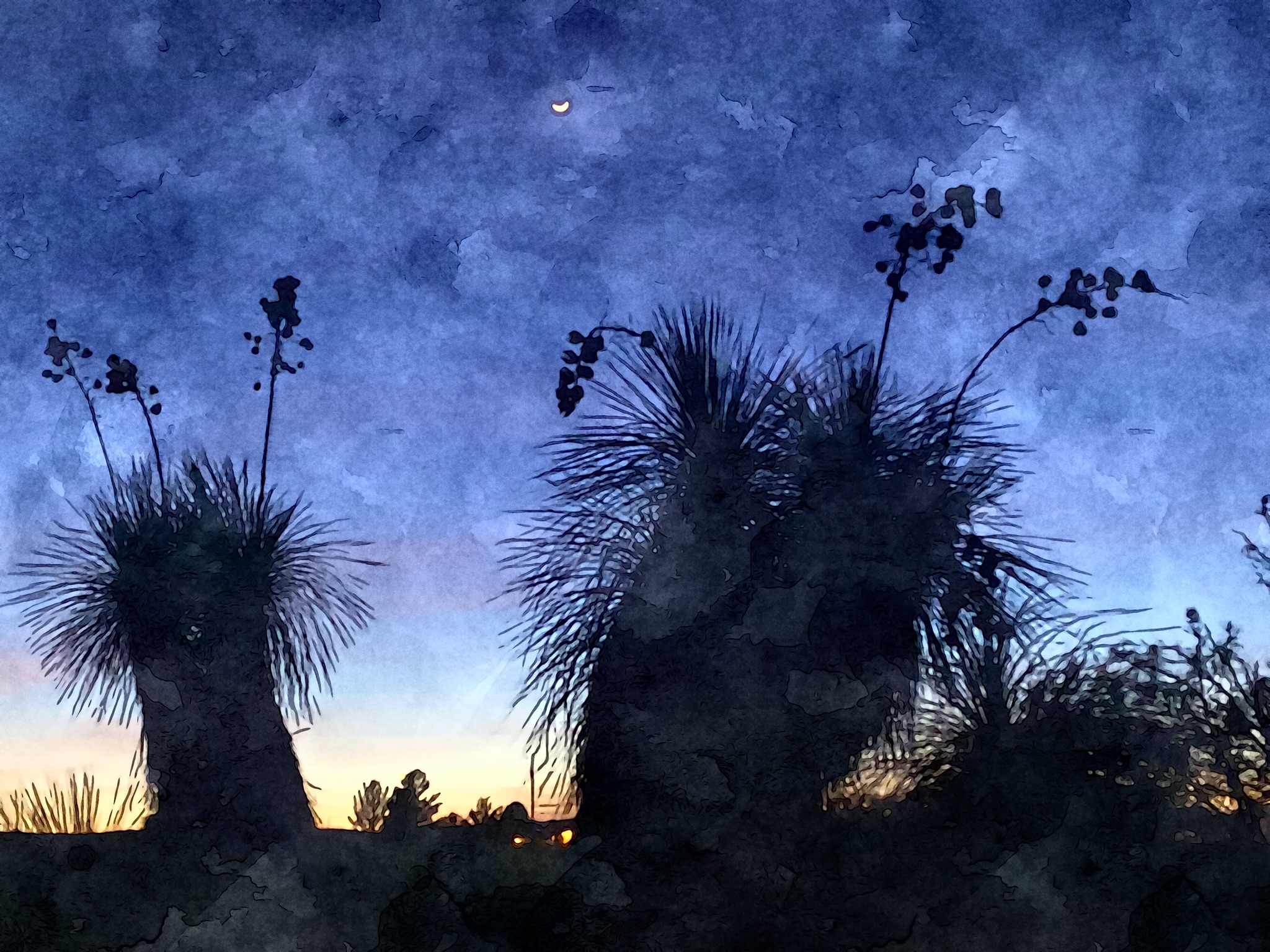
Night Witness by David Morrison (filtered photo, 2023)
- David L. Bartlett, from Feasting on the Word: Year B, Volume 1: Advent through Transfiguration (Feasting on the Word: Year B volume) (pp. 201-202).
- Paul Williams, “Rainbow Connection,” released 1979.